Saturday, January 29, 2011
 Image via WikipediaAs God’s chosen ones, holy and beloved, clothe yourselves with compassion, kindness, humility, meekness, and patience. Bear with one another and, if anyone has a complaint against another, forgive each other; just as the Lord has forgiven you, so you also must forgive. Above all, clothe yourselves with love, which binds everything together in perfect harmony. And let the peace of Christ rule in your hearts, to which indeed you were called in the one body. And be thankful.
Wednesday, November 17, 2010
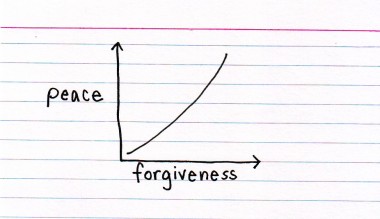
Please excuse the "downer" title. But that's where I am right now. I am dealing with death. This is not the death of a relative of mine. This is not someone I have known my whole life or grown up with. It's the death of a friend...a friend who happens to be connected to our church. And it comes on the heels of a death two weeks ago of another person connected to the church. Both are tragic. Both are families I've grown to love over the last 10 years.
This is a difficult place for me. It's difficult because most of the deaths I deal with -- in the community or fire department -- I kind of come into persons' lives at the moment of their deepest grief and then fade away. Their friends weren't really my friends. They were passing through Girdwood. They were not part of my church family and the call for ongoing pastoral care was not really there.
These are different. I'm emotionally invested here more than usual.
And it's affecting me, emotionally, more than usual.
It's interesting as all the words of advice I normally give to the families who have lost loved ones I have to listen to myself. "Get sleep. Eat well. Get some exercise. Take care of yourself." It's a lot easier to say than it is to do.
It's like I know what to do with everybody else but I'm not quite sure I know what to do with myself. Do I want to talk about it? Do I want to be by myself? Do I want to write about it? Should I go into Anchorage to meet with my pastor friends for some care or should I get out in the sunshine for a walk to take care of myself? (Today I've chosen a walk).
It's interesting that I'm really not doing "OK" with this. This is, I think, the first time in years I've been here that as many people have asked if I'm doing OK or have asked my lovely wife if I were doing OK. I guess that they assume that I'm having some trouble. They're right. I'm not OK. I will be. And, for now, I'm not sure what it is that will move me in that direction. But I will be OK. It may, however, take me a couple of weeks to begin to feel like normal.
This is a difficult place for me. It's difficult because most of the deaths I deal with -- in the community or fire department -- I kind of come into persons' lives at the moment of their deepest grief and then fade away. Their friends weren't really my friends. They were passing through Girdwood. They were not part of my church family and the call for ongoing pastoral care was not really there.
These are different. I'm emotionally invested here more than usual.
And it's affecting me, emotionally, more than usual.
It's interesting as all the words of advice I normally give to the families who have lost loved ones I have to listen to myself. "Get sleep. Eat well. Get some exercise. Take care of yourself." It's a lot easier to say than it is to do.
It's like I know what to do with everybody else but I'm not quite sure I know what to do with myself. Do I want to talk about it? Do I want to be by myself? Do I want to write about it? Should I go into Anchorage to meet with my pastor friends for some care or should I get out in the sunshine for a walk to take care of myself? (Today I've chosen a walk).
It's interesting that I'm really not doing "OK" with this. This is, I think, the first time in years I've been here that as many people have asked if I'm doing OK or have asked my lovely wife if I were doing OK. I guess that they assume that I'm having some trouble. They're right. I'm not OK. I will be. And, for now, I'm not sure what it is that will move me in that direction. But I will be OK. It may, however, take me a couple of weeks to begin to feel like normal.

Sunday, November 14, 2010
 photo © 2007 Fabio Venni | more info (via: Wylio)
Text: Philippians 4:10-14 & Deuteronomy 8:11-18
Title: “Simple Stewardship: Simply Give”
Because we had such a great presentation from the Gideons, I’m going to keep this a little shorter than usual today…and probably quite a bit shorter than many “concluding sermons” for a stewardship drive. This would probably be the sermon where the pastor pulls out all the stops, pulls on every heartstrings, tells you to think about the children, and implies that an angel cries when you give anything less than 10% of your income to the church.
As fun as that may sound, this is “Simple Stewardship.”
We’ve been saying that stewardship could be simplified to some base concepts.
FIRST -- SIMPLY BELIEVE – Believe that we have a God who’s big enough to provide for you…and when you give, God will take care of you. God, the creator of the heavens and the earth will be with you if you nudge up your giving. Believing that you couldn’t possibly give more…for almost everybody…is a belief that God couldn’t possibly provide enough. Don’t sell him short.
SECOND -- SIMPLY SERVE – Our giving is an act of service. Because you give, we can have a food pantry, we can have someone to counsel those who have lost loved ones, we can have Vacation Bible School, and we can, “through our apportionments (our giving to the Alaska United Methodist Conference) be in mission and ministry around the world. When we give, we think beyond ourselves to others.
And, today, it’s SIMPLY GIVE.
But why?
This week I went into Anchorage to see my allergist, so I could move to allergy shots every other week instead of every week. The visit took one and half hours. And it wasn’t because of the various tests they ran. It took a long time because the doctor and I were talking about Jewish law.
I told the doctor, who is Jewish, that I had been talking with folks recently about the grieving process and how, when someone you loves dies, one of the problems is that, while your world comes to a screeching halt, the rest of the world keeps on spinning. People go to work. People, who are very sorry for your loss, have their lives to manage. There are places to go. Days and nights come and go. And it can be so difficult, after trauma in your life, to figure out how to work your way back onto the world again.
The Jewish Law, I said, gives guidelines for this. It’s a process. There’s a seven-day SHIVA period when you isolate yourself and your family. Food may be provided. Torn garments are worn to symbolize the loss and the pain. It’s a week of great grief where the community supports the mourners.
Then for 23 more days, there’s the practice of SHLOSHIM. The family reenters the community. Engagements are limited. It’s recognized that pain is still present but that community life can begin
again.
And, if one has lost a parent, mourning goes on for a full year until, after a year’s time, one is not considered a mourner anymore.
What I talked with my doctor about is how beautiful and healthy and wholesome this is. It doesn’t shelter anyone from the realities of death and pain and loss. It recognizes community. It recognizes the need for mourners to grieve, even as they make their way back onto the spinning world that never really stopped for them in the first place. What might, by some, seem like overly restrictive rules and regulations is for us.
And the doctor shared how this rang true in his own life when his parents died and how he remembers the anniversary of their death in worship each year.
Says AISH.COM, the largest Jewish content website these days:
Judaism provides a beautiful, structured approach to mourning that involves three stages. When followed carefully, these stages guide mourners through the tragic loss and pain and gradually ease them back into the world. One mourner said her journey through the stages of mourning was like being in a cocoon. At first she felt numb and not perceptively alive, yet gradually she emerged as a butterfly ready again to fly.
The loss is forever, but the psychological, emotional, and spiritual healing that takes place at every stage is necessary and healthy.This Jewish law and ritual actually brings life.
This brings us, if you can believe it, to giving...
I can spell out for you all the things the bible says about giving…but I won’t. It doesn’t really mince words.
We talk about tithes because that’s what’s in there. It's what the Bible says:
“Then Melchizedek king of Salem brought out bread and wine. He was priest of God Most High, and he blessed Abram …. Then Abram gave him a tenth of everything (Genesis 14:18-20 NIV).This is where it begins.
Abram, later Abraham, had his spoils from battle with a nearby king and he sees Melchizedek. And, because he sees that he is someone who is with God, Abram gives him one tenth of what he had received. This sets it all up; the process of giving ten percent of our increase back to God.
This was a sign of the covenant. But you and I both know that sometimes it’s hard to relinquish any…let alone 10% of what we’ve been given. Some people sit with calculators making sure to tip their server 15% after good service and a good burger and fries, but giving extra to God for his service can give us fits.
We’re not alone. Israel had that trouble as well. There were times that they held onto what they had and forgot the tithe and things got bad for them. That’s where the prophets came in, to call persons back to God and why Malachi does this so well in Chapter 3:
“I the LORD do not change. So you, the descendants of Jacob, are not destroyed. Ever since the time of your ancestors you have turned away from my decrees and have not kept them. Return to me, and I will return to you,” says the LORD Almighty.
“But you ask, ‘How are we to return?’
“Will a mere mortal rob God? Yet you rob me.
“But you ask, ‘How are we robbing you?’
“In tithes and offerings. You are under a curse—your whole nation—because you are robbing me. Bring the whole tithe into the storehouse, that there may be food in my house. Test me in this,” says the LORD Almighty, “and see if I will not throw open the floodgates of heaven and pour out so much blessing that there will not be room enough to store it. I will prevent pests from devouring your crops, and the vines in your fields will not drop their fruit before it is ripe,” says the LORD Almighty. “Then all the nations will call you blessed, for yours will be a delightful land,” says the LORD Almighty.The Deuteronomy text we read before, begins with:
Be careful that you do not forget the LORD your God, failing to observe his commands, his laws and his decrees that I am giving you this day.And then it says that if you fail to follow the commands, you’ll forget the Lord and fall away from his covenant. We’re not going to burn anyone with unquenchable fire here, but it’s clear that holding back on our giving, is detrimental to our relationship with God. Our holding back gets in the way.
This makes sense. Sheila ________, at our meeting last week, used an illustration from Dave Ramsey. She said that, when you’re holing onto your money, you have tight fists around it. Nothing is going to get out. But nothing is going to get in. When we are generous with our gifts, it makes it possible for us to receive as well as give. It opens us up to God’s blessings and reminds us, in our wallets, that we have a God who does provide for us, that he will take care of us. And that’s the relationship he wants to have with us.
As I talked with my allergist this past week about Jewish laws and regulations for mourning, we talked about how these laws and regulations, while hard to follow, while misunderstood, while countercultural, are designed to help those very persons who have suffered loss in their life. They bring persons into community and into a proper relationship with the God who gives and takes away.
The Scriptural rules and regulations and understandings about giving are hard to follow, misunderstood, and very much countercultural. I know it can be hard to hear, but they really aren’t about meeting a church budget or being asked to support a new church construction or fund a pastor or even some wonderful, holy, life-changing ministry. They are designed to help the very persons who have an income, and increase, material things. They bring persons into community and bring us into a proper relationship with the God who gives and takes away. It also fights against the impulse to make an idol of material things. It reminds us who we are and who God is. It’s about faithfulness and holiness.
In this place you will be defined by the sacrifice of Christ, by a God who loved the world so much that he gave his only begotten son that whosoever believes in him will not die but have eternal life. That will define you here…God’s love for you. You will never be defined by how much you give or don’t give. You will never be defined by what percentage of your income you offer to God. There won’t be bigger crowns in heaven for the larger portion of guilt that you carry as you go to write your check. That won’t define you.
You are defined as a loved child of God with whom God wants to be in relationship with.
Part of that relationship, a prominent but challenging part, is stewardship. To put it simply. SIMPLY BELIEVE. SIMPLY SERVE. SIMPLY GIVE.
In the name of the Father, and of the Son, and of the Holy Spirit. Amen.
 Image by crunklygill via FlickrText: 2 Corinthians 8:1-15 & John 13:31-25
Title: “Simple Stewardship: Simply Serve”
A little over a month ago I went into the Alaska United Methodist Conference office with Sheila _______ (our money person) and Steve _______ (our “building” person). To meet with Dave _______ and Leila _______ (our Conference Leadership Persons). We met with them to talk about our church finances, which, the farther along we’ve been getting in our construction without actually occupying the building, the harder it’s been. And we knew that this year, as we were looking at what we’ve had on our plate to get heat and start worshipping over there, it was becoming more and more evident that our “income” wasn’t meeting up with out “outgo.”
And we’ve tried to be honest and forthcoming here. The longer we’ve had to wait for construction to finish, we’ve been paying bills for a building we’ve not been able to occupy. And we could see that it was going to get a little too close for comfort as we got to the second half of this year and into the beginning next year as we’ve had some large chunks of money due at one time while giving has gone down a bit.
And we’re there now. I won’t get into all the details here, but know that we’re struggling to cover some of our basic bills—even things like my salary and the building insurance—all the time as we strive to increase the amount of ministry done in the community.
Well, we went to the Conference office to seek some guidance, knowing that we need to keep pushing to be in that space next door. Well, from that meeting, I found out there is a fund set aside by the Conference called “The Mission Aid” fund. It’s a fund built up from APPORTIONMENTS – which is a collection of money all the United Methodist Churches put into to keep up with the functioning of the conference but also for mission work both here and around the world. Some people—particularly those in the South and Midwest—view APPORTIONMENTS as a HEAD TAX or a “fee” for having members. It’s not that. Really, APPORTIONMENTS are A PORTION MEANT FOR OTHERS. It’s giving beyond ourselves. And because of that giving from United Methodist Churches around Alaska, our church is getting $7,000 which we’ve said that we would apply to my insurance and pension contributions, which we’re behind on. It’s a gift for us.
But, many of you know, that’s not the only way we’ve been helped by others throughout this building process. BY NO MEANS! (As the Apostle Paul says a couple of times.) Really, it’s breathtaking when you think of all the financial help we’ve gotten just to get in the place we are…with a full-time pastor and some active ministries and a nearly completed building – where I was able to write my sermon this week.
Did you know that, in 2006, 2007, 2008, and 2009 – each year – we took in over $50,000 from Christians around the US to put towards, not just our building, but also our ministry? That number’s going down some which is why, this week I need to start mapping out a trip to Mississippi this winter, to visit churches.
And that $200,000 doesn’t include the vast generosity of churches that have held bake sales and cookbook sales and carwashes and special offerings to send work teams up to Girdwood, Alaska to help us build. I think it’s 34 work teams—with an average of 12 people. That’s over 400 tickets to Alaska with rental cars and food and some supplies and, at about $1,500 per person, that’s another financial gift of $600,000 just so people could come and work for us and with us.
I’m done saying we’ll be in that new sanctuary on this or that date. Been heartbroken too many times for that. But I know that, as we sit over here today, soon we’ll be over there. And the hope and the promise of that is only because of the grace and kindness and gifts of – not just the people you see around us today – but a whole lot of other people. People have been generous with us.
We are talking about STEWARDSHIP over this three-week period. And I’m trying to think of just how simple I can make the concept so that you appreciate its importance in the lives of, not just our church, but all followers of Jesus. I said, if I could break this concept down into just the very important parts to know and understand, I’d say that SIMPLE STEWARDSHIP means SIMPLY BELIEVE, SIMPLY SERVE, SIMPLY GIVE.
Last week we talked about that BELIEF aspect. This is a tough one in our culture where we have a sense that there just isn’t enough to go around, and so we worry about what we have and how much we have and how much everyone else has. There’s a SPRIRIT OF SCARCITY which makes us hold onto what we have.
But part of what we need to do as Christians is to recognize that we have a very big God…one who even created the heavens and the earth…and through his PROVIDENCE he will take care of us. And, even if we loosen our grip on our money by 10%, a biblical tithe, he will take care of us. He’ll make sure that we have enough…more than enough…to keep on going. If you don’t believe that God will take care of you…well, then you have to rely on other things, such as money, for backup…in case God fails to come through.
That’s the first aspect of a SIMPLE STEWARDSHIP. SIMPLY BELIEVE.
The part I wanted to get to today is SIMPLY SERVE.
We’re all well aware that our God is a serving God and our Jesus is a serving Jesus. In fact, that passage we read before kind of gets right at it. Jesus has come to the Passover Meal with the disciples…although they don’t know it’s “The Last Supper” yet. And as the meal is set to begin, Jesus does the strangest thing. He takes off his outer robe and begins to wash the disciple’s feet. Now, remember, this is Ancient Israel. Sandals. Dusty roads. Dirty feet. This was the job of a servant, not of the Messiah. Peter protests, but then relents. And then the meal begins. After the meal he gives them a “new commandment.” He says:
“I give you a new commandment, that you love one another. By this everyone will know that you are my disciples, if you have love for one another.”
And that love…, well, it’s shown through service…through washing feet, through offering food, and bread and juice. That’s how it’s shown to the disciples…and us.
It’s also shown to us through churches coming together to help us with our benefits or people around the US giving $50,000 a year to help us build.
Now, I hope it goes mostly without saying that service is important in the Christian life. After all, Jesus said for us to take up our crosses. He said that he came to serve and offer his life as a ransom for many. And if we look at his life, he went out of his way to serve others…to minister to the hurting and the lost, to reach out to the social or economic outcast, and, of course, to die on a cross for the sins of the world. Service…, well, that’s part of what made this Messiah different than the military and political Messiah that a lot of folks expected. They expected someone to ride into Jerusalem on a stallion, with army behind him….not on a donkey. This was a different kind of King.
And so, we know that we should do good things for people. We know that we should have things like a food pantry and that we should help persons who are homeless or are having problems with their kids or their jobs or their marriage. For that’s part and parcel of the Savior we say we believe in.
We are thankful for those who have served in our church in this way…for the committee folks…for the construction folks…for the people who’ve served as mentors for kids…for those who have cleaned Little Bears or shoveled the chapel roof or chopped wood or whatever.
That’s good stewardship of time. That’s serving through our talents and time and spiritual gifts.
But stewardship of money is also connected to service…in a big way. See, money is AMORAL as Dave Ramsay says. Money is neither good nor bad in and of itself. It’s just money. It’s like a brick. A brick is neither good nor bad…in and of itself. It can be used for good or bad purposes. It can be used to build a hospital…or it can be thrown through a window. And money can be used for good or bad purposes. It can buy things that are unneeded, unwanted, unhelpful in this life. It can be stored with more and more money out of fear that we’ll never have ENOUGH. OR…it can be used to serve.
We can’t really wash the disciples’ feet with money, but we can use it to help those in need.
We had fun a few weeks ago in Bible Study looking at Paul’s words to the Corinthians in 2 Corinthians 8, which is one of the most thorough explanations of stewardship in the Bible. Well, at least I had fun with it.
The scenario is that times are tough for the Jerusalem church. Poverty there is bad. They need help. And Paul’s taking up a collection along his journeys, in order to help support those Jerusalem Christians.
In 2 Corinthians 8, Paul talks about the Macedonian Christians and, essentially, says “You know how bad they have had it in Macedonia. Well, let me tell you they have been graced by the grace of Christ and even amidst their poverty they have responded generously. They are eager, out of their poverty, to help the saints of Jerusalem. He says, to the Corinthians:
“…for during a severe ordeal of affliction , their abundant joy and their extreme poverty have overflowed in a wealth of generosity on their part. For, as I can testify, they voluntarily gave according to their means, and even beyond their means, begging us earnestly for the privilege of sharing in this ministry to the saints.”
So…you Corinthians, who also have been blessed by God and others, and who are not in a severe ordeal of affliction at this point…will you, also, excel in this undertaking? Remember how well those Macedonians excelled…as I was just saying.
One of the Bible study folks said they hadn’t realized how amusing Paul can be at times. He really is funny in places. And this is one of them. It would be like me standing up before the offering plate was passed and say something like this...
Friends, before you reach into your wallets and open up your checkbooks, I want to ask if you’ve been blessed by God. I know you have. But I want you to answer that question. Well, if God has blessed you so much then we need to address what we should do with this blessing. There are people in this community, in this world of ours who need some help. They need to be served. And the Bible tells us that we love because he first loved us. Well, you’ve been loved. So, we can, in turn, love with what we’ve been given.
And, before that plate is passed, I’d like you to consider, for example, the fact that we’ve had three workteams from Elkhart, Indiana over the years…a place so depressed that MSNBC had a special place on their website to talk about the unemployment and depression there. And this is a community that was so very generous with their gifts to you. They excelled in their giving. Will you excel in this present undertaking?
I couldn’t do that.
Paul’s got some guts.
But more than guts, it’s true.
Yes, we need funds for the building…not so that we can complete the building, but so that we can start using it for ministry.
Yes, we need funds for my salary…not so that I have money in my pocket, but so we can afford to keep a full-time pastor here, doing what I hope you think is valuable ministry to and with the community.
Yes, we need funds for the heat, and the mortgage, and the phone line…not so the lights stay on for us but so they stay on for all who might need this place.
Paul says, closing out his discussion of the collection:
“The one who had much did not have too much, and the one who had little did not have too little.”
I’m not going to say that you have too much. I’ll say that I have too much. But I won’t speak for you. But I will say that pretty much everyone here has more than ENOUGH. Well, what if we could serve by offering up some of that MORE THAN ENOUGH to others – through the work of this church.
That’s what others have done for us.
If you want to have a very basic understanding of stewardship, you need to SIIMPLY BELIEVE and SIMPLY SERVE.
In the name of the Father, and of the Son, and of the Holy Spirit. Amen.

Subscribe to:
Posts (Atom)